
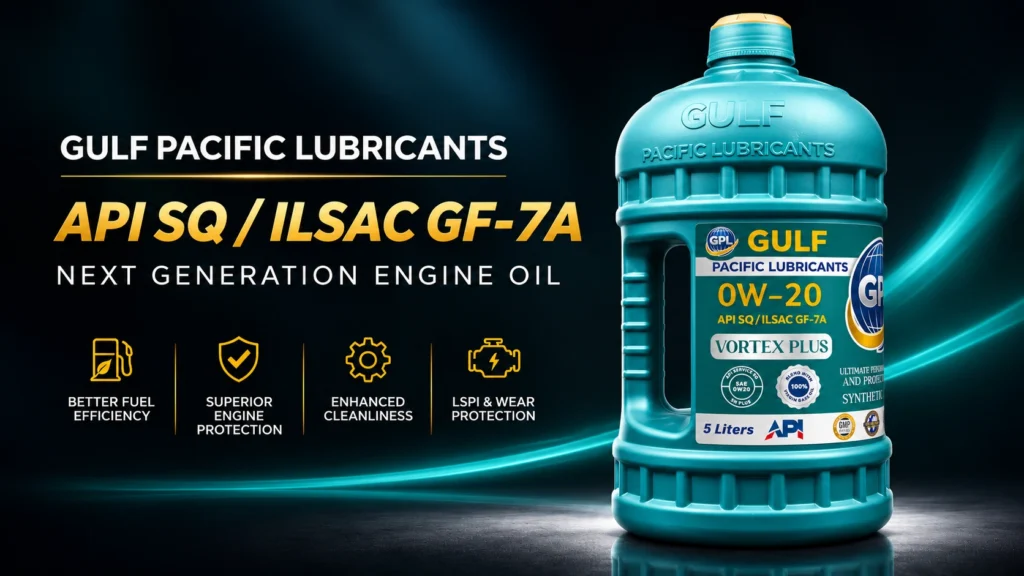
Understanding API SQ vs API SP is important when selecting the right engine oil for modern gasoline engines. Both are performance categories established by the American Petroleum Institute (API). Introduced in March 2025, API SQ builds upon API SP with updated engine protection, deposit control and performance requirements.
What Is API SP Engine Oil?
Introduced in May 2020, API SP was developed to address the lubrication requirements of modern gasoline engines, including turbocharged gasoline direct injection (TGDI) engines.
Its key benefits include:
- Protection against low-speed pre-ignition (LSPI).
- Improved timing chain wear protection.
- Control of high-temperature deposits.
- Improved oxidation resistance.
- Protection against sludge and varnish formation.
What Is API SQ Engine Oil?
API SQ is a newer gasoline engine oil performance category designed to address evolving engine technologies and increasingly demanding operating conditions.
It builds on the performance requirements of API SP, including enhanced protection against low-speed pre-ignition, improved deposit control and additional performance requirements.
API SQ was introduced alongside the ILSAC GF-7A and GF-7B standards, which address requirements including fuel economy and engine protection.
API SQ vs API SP: Key Differences
| Feature | API SP | API SQ |
|---|---|---|
| Introduction | May 2020 | March 2025 |
| Engine technology | Modern gasoline engines | Latest-generation gasoline engines |
| LSPI protection | Yes | Enhanced requirements |
| Timing chain protection | Yes | Continued protection requirements |
| Deposit control | Advanced | Updated requirements |
| Related ILSAC standards | GF-6A and GF-6B | GF-7A and GF-7B |
| Backward compatibility | Earlier gasoline categories | API SP and earlier gasoline categories |
Is API SQ Better Than API SP?
API SQ introduces updated performance requirements compared with API SP. However, the correct engine oil depends on the vehicle manufacturer’s recommended viscosity grade, performance specification and applicable OEM approvals.
Vehicle owners should always consult their owner’s manual before selecting an engine oil.
Can API SQ Replace API SP?
Generally, API SQ engine oils are backward compatible with gasoline engines requiring API SP and earlier API gasoline service categories, provided the correct viscosity grade and other manufacturer requirements are satisfied.
Engine Oil Manufacturing at Gulf Pacific Lubricants
Gulf Pacific Lubricants FZC (GPL) is a lubricant manufacturer based in Sharjah, United Arab Emirates, specializing in automotive, industrial and marine lubricants.
GPL offers a comprehensive range of engine oils developed to address diverse vehicle technologies and operating requirements. With over 200 product formulations and an international presence across 40+ countries, GPL supports distributors, wholesalers and automotive businesses worldwide.
Explore our lubricant range at https://gulfgpl.com/
Frequently Asked Questions
When was API SQ introduced?
API SQ first became available for licensing on March 31, 2025.
Is API SQ newer than API SP?
Yes. API SQ is the newer gasoline engine oil performance category, following API SP.
Is API SQ suitable for diesel engines?
API SQ is a gasoline engine oil category. Diesel engines require lubricants that meet the applicable diesel engine specifications.
Is API SQ the same as ILSAC GF-7?
No. API SQ and ILSAC GF-7 are related but distinct standards with different performance and applicability requirements.
Does API SQ specify engine oil viscosity?
No. API SQ defines performance requirements. SAE viscosity grades such as 0W-20 and 5W-30 describe the oil’s viscosity characteristics.
Conclusion
API SQ represents an advancement in gasoline engine oil performance standards. While API SP remains suitable for many vehicles, API SQ provides updated performance requirements for modern engine technologies. Selecting the correct lubricant according to manufacturer recommendations remains essential for reliable engine protection.
Technical reference: American Petroleum Institute — www.api.org